When you look for the best way to keep mosquitoes away, you want something that works and feels safe. In 2025, lemon eucalyptus stands out as the leading scent in mosquito repellent products. You see this ingredient everywhere—from sprays to candles—because it offers strong protection and a fresh, pleasant aroma. People love natural options, and lemon eucalyptus fits the bill. You also find citronella, eucalyptus, and lemongrass topping the charts in consumer reviews. These scents are popular because they help you avoid harsh chemicals and still get reliable results.
Here’s a quick look at the scents mosquitoes hate most, according to entomologists and pest control experts:
Citronella: Herbal and lemon fragrance that mosquitoes avoid.
Rosemary: Fresh, woodsy scent that drives mosquitoes away.
Lemon Balm: Bold citrus scent that keeps mosquitoes at bay.
Coffee: Strong scent that deters mosquitoes.
Lavender: Soft scent that makes mosquitoes retreat.
Catnip: Invigorating scent that mosquitoes dislike.
Garlic: Pungent scent that protects against mosquitoes.
Eucalyptus: Repulsive scent that hinders mosquitoes' ability to smell.
Peppermint: Scent that mosquitoes detest.
Marigolds: Fragrance that is toxic to mosquitoes.
Lemon eucalyptus and citronella lead the pack in 2025. You find these scents in the most trusted mosquito repellent products, and they’re backed by science and consumer preference.
You might wonder why mosquitoes steer clear of these scents. The answer lies in how their senses work. Mosquitoes use their antennae to sniff out carbon dioxide and lactic acid from your skin. When you apply a repellent with lemon eucalyptus or citronella, you overwhelm their sensory organs. The strong aroma confuses them and blocks their ability to find you.
Studies show that lemon eucalyptus repellent can protect you for 6-8 hours, which matches the performance of 20% DEET. Citronellal derivatives also last longer than DEET in some tests. These natural compounds—like eucalyptol and methyl salicylate—interact with mosquito olfactory receptors. They either activate or inhibit the receptors, making it hard for mosquitoes to track you down.
Note: Lavender’s aroma is pleasant for you but repulsive for mosquitoes. It disrupts their odor-sensing activity and makes them retreat.
Mosquitoes have a complex sense of smell. They can learn and adapt to host cues, but scents like lemon eucalyptus and citronella throw them off balance. When you use a repellent with these ingredients, you make yourself invisible to mosquitoes. You get peace of mind and enjoy your time outdoors without constant swatting.
You might wonder why mosquitoes seem to find you so easily. Mosquitoes use their antennae to pick up scents from your skin and breath. They track carbon dioxide, lactic acid, and other chemicals that your body releases. When you use a repellent, you change the way mosquitoes sense you. Scents like lemon eucalyptus and citronella disrupt their ability to locate you.
Here’s a quick look at how different scents affect mosquito behavior:
Evidence | Description |
|---|---|
Natural Repellents | Lemongrass oil and oil of lemon eucalyptus activate mosquito olfactory neurons, confusing their sense of smell. |
Human-made Repellents | DEET and Picaridin mask human odors, making it hard for mosquitoes to find you. |
Concentration Requirement | You need at least 30% concentration of synthetic repellents to block skin odors. |
Behavioral Response | Mosquito species like Anopheles, Aedes, and Culex react differently, but natural scents often work best. |
Mosquitoes also respond to your skin’s microbiome. The bacteria on your skin produce scents that attract mosquitoes. Some skin volatiles, like methyl butyric acids, can reduce mosquito landings by almost 99%. Terpenes such as geraniol also lower mosquito attraction.
Tip: If you want to boost your protection, choose a repellent with lemon eucalyptus or citronella. These scents confuse mosquitoes and make you less attractive to them.
Recent studies show that oil of lemon eucalyptus is the top natural repellent. The CDC ranks it just behind DEET and picaridin for effectiveness. Citronella oil works well at high concentrations, but its protection drops at lower levels. The CDC and EPA both recommend oil of lemon eucalyptus for safety and performance. It’s the only natural repellent registered with the EPA.
Oil of lemon eucalyptus is highly effective and safe.
Citronella oil masks scents that attract mosquitoes.
Lemongrass oil repels mosquitoes and other pests.
Peppermint and garlic also deter mosquitoes.
Researchers tested natural repellents like citronella oil against DEET. They found that botanical repellents can be good alternatives, especially for people who want to avoid synthetic chemicals. Studies highlight the need for improved formulas to make natural repellents last longer.
Note: Always check the label for concentration and safety information before using any repellent.
Choosing the right mosquito repellent product can make your summer much more enjoyable. You want something that works, feels safe, and fits your lifestyle. Let’s break down the best insect repellents, sprays and lotions, and candles and devices for 2025.
You have plenty of options when searching for the best insect repellents. Consumer reports and independent labs rate these products highly for effectiveness:
EarthKind Stay Away Mosquitos Insect Repellent Unscented
Cutter All Family Insect Repellent with IR3535
Zevo On Body Mosquito and Tick Repellent Pump Spray
Ben's Adventure Formula Sweat Resistant Tick & Insect Repellent
Murphy’s Naturals Lemon Eucalyptus Oil Spray
Thermacell E65 Rechargeable Mosquito Repeller
OFF! Deep Woods Insect Repellent
Sawyer Products Picaridin Insect Repellent
Cutter Dry Insect Repellent
OFF! Backyard Pretreat
You find these mosquito repellent products in stores and online. They come in different formats, so you can pick what works best for you.
Sprays and lotions give you direct protection. You apply them to your skin or clothing, and they keep mosquitoes away for hours. Many of the best bug sprays use active ingredients that have proven results. Here’s a quick look at what’s inside top-rated bug repellent products:
Product Name | Active Ingredient | Scent | Effectiveness Duration |
|---|---|---|---|
EarthKind Stay Away Mosquitoes | 20% Picaridin | Unscented | Up to 8 hours against biting flies, 14 hours for mosquitoes and ticks |
Murphy’s Naturals Lemon Eucalyptus | Oil of Lemon Eucalyptus | Lemon Eucalyptus | Up to 6 hours against mosquitoes |
Sawyer Products Picaridin | 20% Picaridin | Fragrance-free | Up to 14 hours against mosquitoes, ticks, and biting flies |
OFF! Deep Woods | DEET | Strong odor | Varies based on concentration |
Cutter All Family | IR3535 | Light scent | Effective against mosquitoes and ticks |
Coleman SkinSmart DEET Free | IR3535 | Light scent | Effective against mosquitoes and ticks |
You notice that Murphy’s Naturals Lemon Eucalyptus stands out as a mosquito repellent product using the most hated scent. It gives you a fresh aroma and solid protection. EarthKind Stay Away Mosquitoes and Sawyer Products Picaridin offer long-lasting defense without strong odors. OFF! Deep Woods remains a classic choice if you want maximum strength.
Tip: If you want a natural option, pick a mosquito repellent product with oil of lemon eucalyptus. It’s effective and smells pleasant.
Candles and devices help you protect larger areas, like patios or campsites. You find citronella candles everywhere, and they use a scent mosquitoes hate. These candles work best in calm conditions and provide short-term protection. You might enjoy the relaxing glow, but don’t rely on them alone for heavy mosquito activity.
Electronic devices, such as the Thermacell E65, release spatial repellents like metofluthrin. These mosquito repellent products create a protective zone around you. Studies show that topical repellents like DEET and picaridin work better than candles or ultrasonic devices. Ultrasonic gadgets sound promising, but research says they don’t actually repel mosquitoes.
Here’s a quick guide to active ingredients in popular mosquito repellent products:
Active Ingredient | Description |
|---|---|
DEET | The standard repellent, effective against various insects, with formulations ranging from 5% to 100%. |
Picaridin | A synthetic repellent, odorless, effective as DEET, safe for infants from 2 months. |
Oil of Lemon Eucalyptus | Based on eucalyptus, effective but not for children under 3 years, can cause skin irritation. |
Metofluthrin | A spatial repellent, currently sold in battery-operated systems, efficacy studies ongoing. |
Catnip | Recently registered, shows effectiveness against mosquitoes, commercial version not yet available. |
Permethrin | Recommended for clothing and gear, effective against various arthropods, remains effective after laundering. |
Oil of Citronella | Used in candles and coils, less effective than skin-applied repellents, suitable for outdoor use. |
You see that oil of lemon eucalyptus and citronella are the scents mosquitoes hate most. Murphy’s Naturals Lemon Eucalyptus Oil Spray and citronella candles use these ingredients. Thermacell E65 uses metofluthrin, which is still being studied but shows promise for spatial protection.
Note: For the most effective insect repellent, use sprays or lotions on your skin and clothing. Candles and devices add extra protection but should not replace topical mosquito repellent products.
If you want to enjoy your backyard or camping trip, combine different mosquito repellent products. Use a spray or lotion for personal protection, and light a citronella candle for your outdoor space. You get the best results when you layer your defenses.
You might wonder how natural scents like lemon eucalyptus stack up against classic repellents like DEET. DEET has been the gold standard for decades. It works by blocking the mosquito’s ability to sense you, giving you strong and long-lasting protection. Lemon eucalyptus, especially the oil called PMD, also confuses the mosquito’s senses. In real-world tests, oil of lemon eucalyptus can protect you for up to 6 hours, which is close to what you get from a mid-strength DEET product.
If you want a natural option, you can trust lemon eucalyptus to keep you safe for most outdoor activities. DEET still lasts longer, especially if you spend a lot of time outside or in areas with heavy mosquito activity. For quick trips or backyard fun, a product with lemon eucalyptus scent does the job well.
Choosing between natural and synthetic repellents depends on your needs and comfort level. Natural repellents, like essential oils and PMD, give you peace of mind if you want to avoid chemicals. They smell pleasant and work well for short periods. Synthetic options, such as DEET, Picaridin, and IR3535, offer longer protection and are safe for most people when used as directed.
Here’s a quick comparison to help you decide:
Repellent Type | Active Ingredients | Safety Profile | Effectiveness | Duration of Protection |
|---|---|---|---|---|
Synthetic | DEET | Safe at low doses | Highly effective | 5-8 hours |
Picaridin | Safe for most people | Comparable to DEET | Up to 5 hours | |
IR3535 | Safe, needs reapplication | Comparable to DEET | 3-8 hours | |
Natural | PMD | Safe, may irritate eyes | Effective, shorter duration | Similar to low-dose DEET |
Essential Oils | Safe, short-lasting | Good for Aedes aegypti | Short duration |
Tip: If you have sensitive skin or want to avoid synthetic chemicals, try a natural repellent first. For longer hikes or travel, a synthetic repellent might give you better peace of mind.
No matter which option you choose, always follow the label instructions. You get the best results when you pick a product that fits your lifestyle and activity level.
You want your Mosquito Repellent Product to work its best, right? Start by choosing the right format for your needs. Sprays and lotions protect your skin directly. Candles and devices create a barrier in your outdoor space. Essential oils like citronella, lavender, and eucalyptus offer a natural way to keep mosquitoes away. You can mix these oils with water and use them in a spray bottle for easy application.
Here’s a quick table to help you maximize effectiveness:
Method | Description |
|---|---|
Essential Oils | Blend citronella, lavender, or eucalyptus with water for a natural spray. |
Strategic Placement | Place Mosquito Repellent Products near doors, windows, and patios. |
Misting Systems | Use professional misting systems for long-lasting protection outdoors. |
Tip: Position your Mosquito Repellent Product where mosquitoes enter your space. You create a strong barrier and enjoy your time outside.
Safety matters when you use any Mosquito Repellent Product. Always apply repellent to exposed skin and follow the directions on the label. Avoid putting repellent under clothing. For children, apply the Mosquito Repellent Product to your hands first, then gently rub it on their skin. Never use strong repellents on babies under three months. Essential oils should be diluted to prevent skin irritation. Try a patch test before using a new Mosquito Repellent Product, especially if you have sensitive skin.
Consult your vet before using Mosquito Repellent Products on pets.
Dilute essential oils for kids and sensitive skin.
Avoid spraying near eyes, mouth, or open wounds.
Some repellents, like DEET or pyrethroids, may cause skin irritation or other side effects. If you notice redness or discomfort, wash the area and switch to a gentler Mosquito Repellent Product.
You get the best protection when you combine Mosquito Repellent Products. Treat your clothing with permethrin and use a spray or lotion on exposed skin. This multi-layered approach keeps mosquitoes away from both your skin and your clothes.
Combination Approach | Benefit |
|---|---|
Permethrin on clothing | Long-lasting barrier against biting insects |
Spray or lotion on skin | Direct protection for exposed areas |
Candles and devices | Extra coverage for outdoor spaces |
Note: Using more than one Mosquito Repellent Product gives you peace of mind and helps you stay bite-free all season.
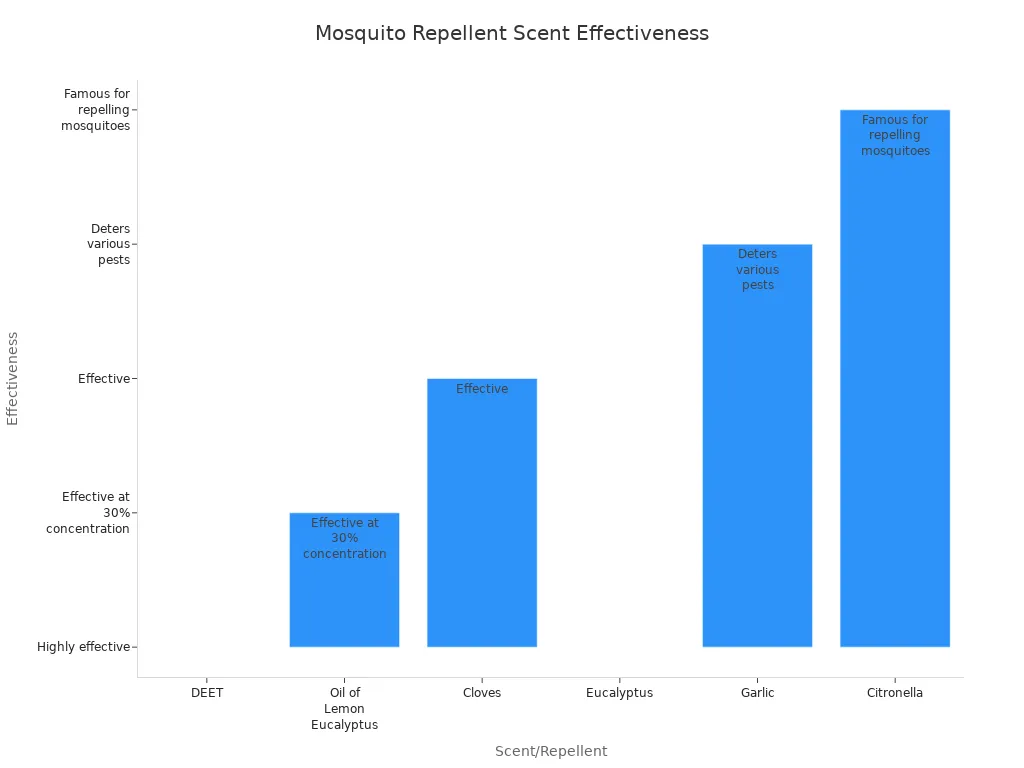
You want the best Mosquito Repellent Product for your summer adventures. Lemon eucalyptus stands out as the most hated scent by mosquitoes. It gives you strong protection and a fresh aroma. Check out the top picks for 2025 in the table below:
Scent/Repellent | Effectiveness | Notes |
|---|---|---|
Oil of Lemon Eucalyptus | Effective | Natural alternative |
DEET | Highly effective | Offensive to mosquitoes |
Citronella | Famous for repelling | Used in candles and devices |
Pick a Mosquito Repellent Product that matches your lifestyle. Stay safe, enjoy the outdoors, and keep those bites away!
You want to keep your kids safe. Choose a Mosquito Repellent Product with oil of lemon eucalyptus or picaridin. Always check the label for age recommendations. Avoid DEET for children under two months.
You should not use human Mosquito Repellent Products on pets. Ask your vet for advice. Some essential oils can harm animals. Look for pet-safe Mosquito Repellent Products if you need protection for your furry friends.
You need to reapply your Mosquito Repellent Product every 4–8 hours. Check the instructions on the label. Sweat, swimming, or heavy activity may reduce protection, so reapply as needed.
Many Mosquito Repellent Products also protect you from ticks. Look for products with picaridin, DEET, or permethrin. Always read the label to make sure your Mosquito Repellent Product covers both mosquitoes and ticks.
You can use Mosquito Repellent Products indoors. Choose sprays or plug-in devices designed for indoor use. Avoid burning citronella candles inside. Always follow safety instructions for your Mosquito Repellent Product.