
Environmental variables—specifically ambient moisture—are the primary culprits behind the mechanical and functional failure of combustible repellents in field applications. High relative humidity alters the physical properties of the binding agents and combustible base materials. This leads to delayed ignition, premature extinguishing, and inconsistent release of active ingredients like pyrethroids required to effectively repel, paralyze, or kill mosquitoes. For distributors, procurement teams, and end-users operating in tropical or damp climates, understanding the thermodynamics of moisture absorption is critical. This guide evaluates how humidity dictates performance and outlines the formulation criteria necessary to select a reliable, climate-resilient mosquito coil.
Moisture Absorption Degrades Combustibility: Wood powder and starch binders are highly hygroscopic; ambient humidity above 70% significantly increases the thermal energy required to achieve ignition.
Burn Rate Inconsistency: High moisture content causes micro-extinguishments along the coil's path, reducing the efficacy of a long burning mosquito coil and disrupting the steady release of repellent vapors.
Formulation Trade-Offs: Smokeless formulations often utilize charcoal or synthetic bases that react differently to moisture compared to traditional sawdust bases, impacting both burn consistency and indoor air quality.
Storage and Packaging as a Priority: For bulk procurement or private label development, specifying moisture-barrier packaging (e.g., foil wrapping, desiccants) is non-negotiable to prevent shelf-life degradation.
Standard formulations consist of active insecticidal ingredients, a combustible base, and binding agents. Manufacturers typically use wood powder, coconut shell powder, or bamboo dust for the base. Starch or synthetic resins serve as the primary binders. These organic materials share a specific vulnerability. They are highly hygroscopic. They naturally draw water vapor from the surrounding air to reach an equilibrium moisture content.
When ambient humidity rises, the cellular structure of the wood powder absorbs water. Capillary action pulls moisture deep into the core of the product. This alters the internal moisture equilibrium. A product manufactured at an optimal 8% to 10% moisture content can quickly swell to 15% or higher in a humid environment. This excess water degrades the overall quality. It dilutes the combustible density and lowers the thermal efficiency of the base.
In field applications, you can physically feel this change. When opening a master carton in a humid warehouse in Florida or Southeast Asia, the products feel slightly heavier and less rigid. The starch matrix absorbs water molecules, which act as a plasticizer. This fundamentally changes the mechanical properties of the product before you even attempt to light it.
Moisture directly affects the mechanical strength of the product. Starch-based binders rely on a specific dry state to maintain rigidity. High humidity softens these binders. The material becomes pliable and weak. Users often snap the coils when attempting to separate intertwined pairs. Mounting a damp product on a metal stand frequently causes the center slot to tear, rendering the product unusable.
Conversely, overly dry conditions present different mechanical failures. Extreme low humidity extracts too much water from the starch matrix. The product becomes brittle. It shatters easily during transit or handling. Manufacturers must establish a strict moisture content threshold during production. Proper curing ensures the product retains enough flexibility to resist snapping while remaining dry enough to burn consistently.
To minimize breakage during field deployment, follow these handling procedures:
Store master cartons in climate-controlled environments until immediately before use.
Gently tap the intertwined pairs on a flat surface to loosen the binding dust before separation.
Push gently from the center slot outward, rather than pulling from the outer rings.
Mount the center slot onto the metal stand at a strict 90-degree angle to prevent lateral tearing.
Lighting a combustible repellent requires overcoming a specific thermal threshold. Moisture introduces a significant energy deficit. When a product absorbs water, the initial heat applied by a match or lighter cannot immediately ignite the base material. The heat energy must first evaporate the trapped surface water. This process relies on the latent heat of vaporization.
Only after the localized water converts to steam can the material temperature rise to its ignition point. In optimal environments with 40% to 50% relative humidity, ignition typically occurs within three to five seconds. In high-humidity environments exceeding 80%, ignition times can easily triple. Users often exhaust multiple matches or hold a lighter until the plastic casing melts just to establish a smoldering ember.
Thermal Energy Requirements for Ignition at Varying Humidity Levels
| Relative Humidity (RH) | Estimated Moisture Content | Average Ignition Time | Combustion Stability |
|---|---|---|---|
| 40% - 50% | 8% - 10% | 3 - 5 seconds | Highly stable, continuous smolder |
| 60% - 70% | 11% - 13% | 6 - 10 seconds | Stable, minor fluctuations in burn rate |
| 80% - 90% | 14% - 16% | 12 - 20 seconds | Unstable, high risk of micro-extinguishments |
| 95%+ | 17%+ | 20+ seconds (often fails) | Severe failure, requires continuous relighting |
Once lit, the smoldering process relies on a continuous transfer of heat. The burning ember must pre-heat the adjacent unburned material. High internal moisture disrupts this thermal chain reaction. As the ember advances, it encounters damp wood powder. The heat energy diverts to boiling off the water rather than sustaining combustion. The temperature of the ember drops.
If the temperature falls below the critical smoldering threshold, the ember dies. This causes micro-extinguishments along the spiral path. This failure severely impacts the performance of a long burning mosquito coil. A product rated for 8 to 12 hours of continuous protection may fail entirely. It might also burn at a severely reduced rate. This lowers the concentration of airborne repellent. The product ultimately fails to paralyze or kill target insects.
Field observations show that premature extinguishing often happens in the outer rings. The outer rings have the highest surface area exposed to ambient moisture. By the time the ember reaches the inner rings, the ambient heat from the outer burn may have slightly dried the core, but the initial failure renders the product ineffective during the early evening hours.
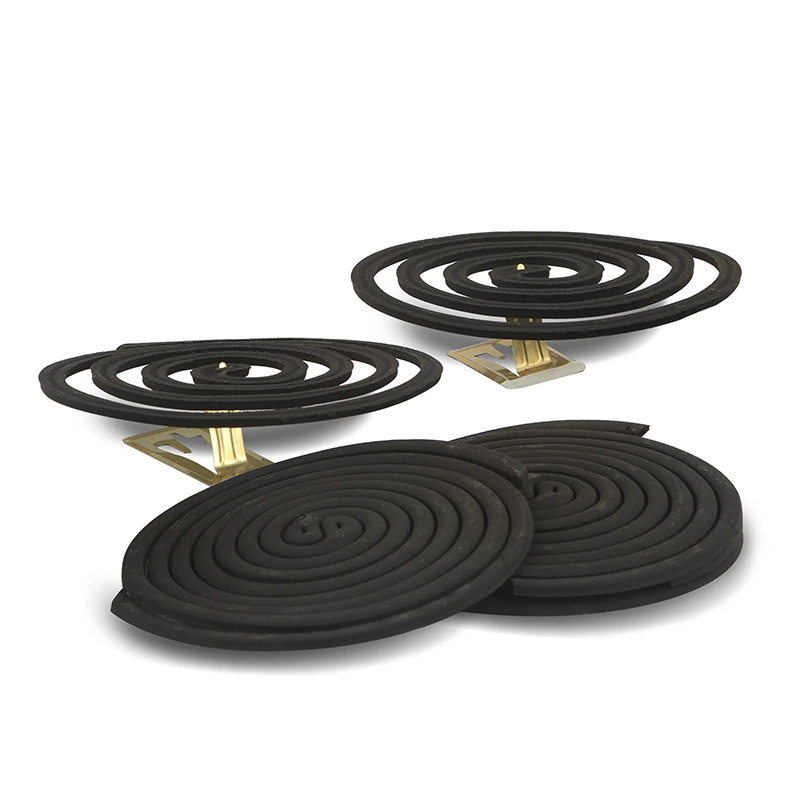
Outdoor environments compound the challenges of moisture absorption. High humidity rarely exists in isolation. It often pairs with variable wind speeds. Deploying an outdoor mosquito coil requires balancing these opposing physical forces. Wind supplies excess oxygen to the ember. This can counteract the dampening effect of moisture by accelerating the burn rate.
However, this accelerated burn introduces a secondary failure. The wind disperses the active ingredient too rapidly. Pyrethroids require a stable vapor cloud to maintain a protective perimeter. Strong breezes blow the repellent away before it can accumulate to lethal or paralyzing concentrations. Users often mistakenly believe the product is defective, when in reality, the environmental fluid dynamics have simply diluted the active zone.
To optimize outdoor deployment, you must strategically place the products. Position them upwind of the target area, but shield them from direct gusts using natural barriers like planters or low retaining walls. This allows the wind to carry the vapor across the patio or campsite without causing the ember to burn through the material too quickly.
Users frequently attempt to manipulate indoor airflow to fix damp products. A common behavior involves placing a fan directly near a struggling, moisture-laden product. The logic assumes forced airflow will encourage burning or circulate the smoke faster. The physics of forced airflow tell a different story.
A fan does supply concentrated oxygen. This helps a damp ember smolder hotter and resist premature extinguishing. However, the high-velocity air severely dilutes the active ingredient concentration. It blows the vaporized pyrethroids across the room too quickly. The spatial repellency drops. Mosquitoes easily penetrate the weakened vapor barrier.
Air conditioning units present similar issues. They dehumidify the air, which helps the product burn, but their strong circulation currents disrupt the steady vapor release. The cold air also causes the vaporized active ingredients to condense and settle on surfaces faster, reducing the airborne hang time required to intercept flying insects.
Burning combustible repellents indoors carries inherent health and safety implications. These risks escalate significantly when dampness causes incomplete combustion. A dry product burns efficiently. It releases a steady, predictable amount of smoke. A damp product struggles to burn. It smolders at a lower temperature, resulting in incomplete combustion.
Incomplete combustion drastically increases the emission of fine and ultrafine particulate matter (PM2.5). It also elevates the release of volatile organic compounds (VOCs). Burning these products for long periods in confined or poorly ventilated areas poses significant acute and chronic respiratory risks.
You must establish strict ventilation requirements. Opening windows slightly or using exhaust fans mitigates these respiratory hazards while maintaining sufficient repellent efficacy. Cross-ventilation is ideal. Crack a window on one side of the room to allow fresh air in, and open a door on the opposite side to let excess smoke escape. This maintains a baseline concentration of pyrethroids without creating a hazardous indoor atmosphere.
Manufacturers offer different base formulations to address varied consumer needs. Traditional sawdust-based products generate more smoke and retain higher moisture levels. They rely on the natural porosity of wood. A smokeless mosquito coil utilizes a different chemical architecture. These formulations often rely on charcoal powder or synthetic carbon bases.
Charcoal possesses a different moisture absorption profile. It generally resists ambient moisture better than raw wood powder. The carbon matrix is denser and less hydrophilic. However, this creates a distinct trade-off. While smokeless products resist structural degradation in damp climates, they can be harder to ignite initially. The denser material compaction requires sustained thermal energy to establish the initial ember. Once lit, they tend to maintain a more consistent smolder in humid conditions compared to their sawdust counterparts.
Formulation Performance Comparison in Humid Environments
| Performance Metric | Traditional Sawdust Base | Charcoal-Based Smokeless Base |
|---|---|---|
| Moisture Absorption Rate | High (Highly Hygroscopic) | Low to Moderate |
| Ignition Difficulty at 80% RH | Moderate to High | High (Due to material density) |
| Burn Consistency in Damp Air | Prone to micro-extinguishments | Highly stable once ignited |
| Structural Integrity (Softening) | High risk of snapping | Maintains rigidity better |
| PM2.5 Emissions (Incomplete Combustion) | High | Low |
Commercial buyers developing a private label mosquito coil for humid markets face specific sourcing challenges. Regions like Southeast Asia or the Southern United States demand climate-resilient formulations. Standard off-the-shelf formulations often fail in these environments. Buyers must implement a rigorous decision framework during supplier selection.
Highlight necessary supplier specifications early in the negotiation process. Demand optimized binder-to-powder ratios. Request the inclusion of moisture-resistant additives during the mixing phase. Insist on rigorous quality assurance testing for damp-climate performance. Suppliers must provide data showing successful burn completion rates at 80% relative humidity. Failing to specify these parameters results in high return rates and damaged brand reputation.
When auditing a factory, review their drying kilns and curing rooms. The product must exit the curing phase at the exact target moisture content. If the factory lacks climate-controlled staging areas, the product will absorb moisture before it even reaches the packaging line.
Proper storage remains the most effective defense against humidity. Moisture ingress occurs long before the user opens the box. Scalable storage solutions prevent this degradation. Warehouses must utilize climate-controlled zones or industrial dehumidifiers. Pallets should never sit directly on concrete floors, as concrete transfers ground moisture upward.
Packaging dictates shelf life. Shrink-wrapping master cartons provides a baseline defense. Individual foil pouches offer the highest level of protection. Assess the return on investment of premium packaging. The upfront cost of laminated foil and silica gel desiccants is negligible compared to the cost of widespread product failure, consumer complaints, and retail returns. Sealed packaging locks the factory moisture content in place until the exact moment of use.
Implement a strict first-in, first-out inventory system. Even with premium packaging, microscopic pinholes in foil or degraded seals can allow moisture ingress over extended periods. Rotating stock ensures the end-user receives a product that performs as engineered.
Damp products introduce unexpected operational risks. When users encounter a product that refuses to light, they often resort to dangerous workarounds. Attempting to force dry a damp product over a stove burner or using a blowtorch leads to accidental fires. Over-igniting the product can cause the entire outer ring to catch flame rather than smolder.
Provide strict guidelines for safe placement. Users must position burning products far away from flammable materials. Curtains, bedding, and loose clothing present the highest risks. Emphasize the absolute necessity of using standardized metal stands or fire-proof receptacles. Ceramic dishes with elevated metal grates offer superior safety. They catch falling ash and prevent the hot ember from contacting wooden tables or plastic surfaces.
Never place a smoldering product directly on a wooden deck or dry grass. The intense localized heat can easily ignite dry organic matter. Always use a non-combustible barrier between the product and the resting surface.
Request environmental testing data, specifically burn completion rates at 80% relative humidity, from your manufacturing partners.
Audit current warehouse storage practices to ensure pallets remain elevated and protected from ambient moisture ingress.
Upgrade packaging specifications to include laminated foil pouches and silica desiccants for high-humidity markets.
Implement standardized metal stands or ceramic receptacles across all deployment sites to mitigate fire hazards.
A: Yes, but it requires sustained heat to evaporate surface moisture first, and it may require relighting if the internal moisture content is too high.
A: Premature extinguishing is typically caused by high ambient humidity dampening the combustible base, or strong winds disrupting the smoldering ember.
A: While a fan might help a damp coil smolder by providing oxygen, it will likely blow the active repellent vapors away, diluting the concentration needed to effectively paralyze or kill mosquitoes.
A: Charcoal-based smokeless coils often absorb moisture differently than wood-powder coils, potentially offering better structural stability, though ignition may still be delayed.
A: Store them in airtight containers, original foil packaging, or with silica gel desiccants in a cool, dry environment away from direct ground contact.
A: High humidity can cause incomplete combustion, which increases the release of fine particulate matter (PM2.5) and smoke, elevating acute and chronic respiratory risks if used in confined or poorly ventilated areas.
A: A high-quality coil should maintain a consistent smolder for 8 to 12 hours, though extreme humidity can extend this time while reducing the effective release rate of the repellent.


